
Learn what online-only jewelry retailers should check before placing a wholesale ring order.
For an online-only jewelry store, choosing wholesale fashion rings involves more than finding attractive designs at a reasonable price. The right inventory has to photograph well, fit the store's target customer, support healthy margins, arrive consistently, and make sense for the way shoppers browse and buy jewelry online. A ring can look fantastic in a supplier catalog yet perform very differently once it appears on a product page.
Successful retailers then evaluate the product, supplier, pricing, presentation, and customer experience as one connected system. This matters in a growing digital retail market. U.S. retail e-commerce sales reached an estimated $326.7 billion in the first quarter of 2026, up 9.8% from the same quarter a year earlier and representing 16.9% of total retail sales.

Why Online-Only Jewelry Stores Need a Different Buying Strategy
An online jewelry business doesn't have a sales associate standing beside the display case to explain a ring's size, finish, color, or proportions. The product page has to do much of that work.
That makes inventory selection especially important. Product photography, measurements, descriptions, reviews, packaging, shipping speed, and return policies all shape how shoppers judge a ring before buying.
The challenge also goes beyond getting traffic. A jewelry retailer can attract thousands of visitors and still struggle to sell if the merchandise does not match customer expectations.
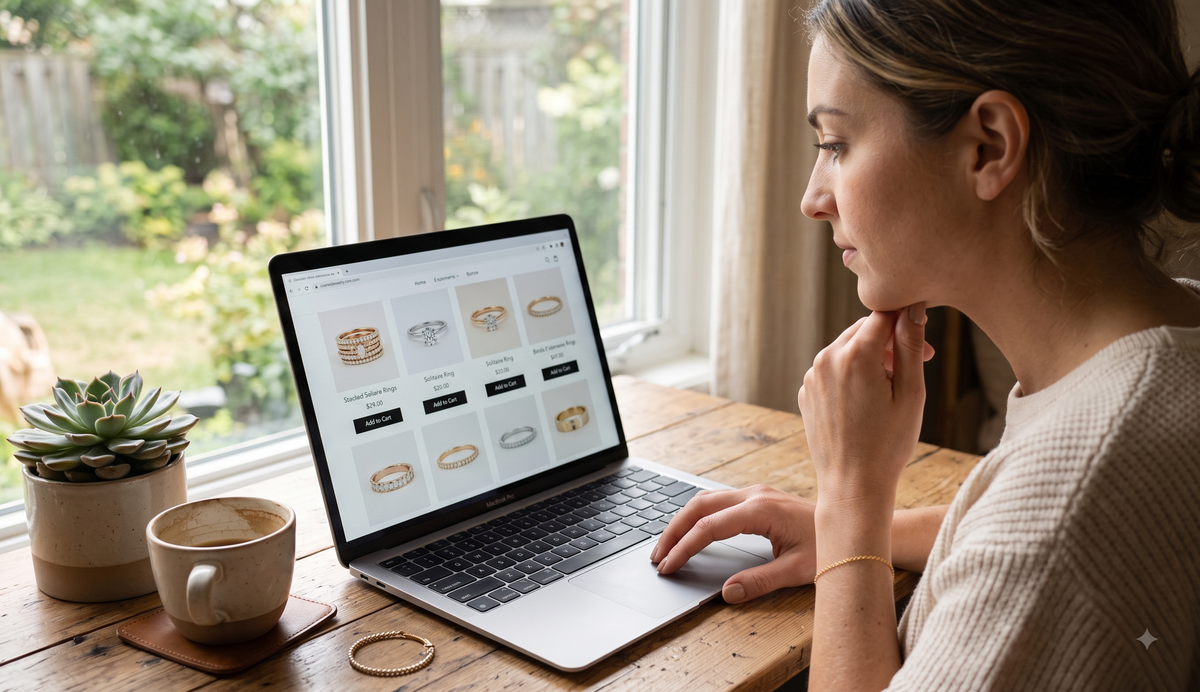
Recent jewelry research reinforces the importance of the digital experience. A2025 Plumb Club survey found that 21% of consumers said a retailer's website was a main influence on jewelry purchases. For an online-only store, that puts the product catalog at the center of the sales process.
What Should Retailers Consider When Buying Wholesale Fashion Rings?
The strongest buying decisions usually come from looking at several factors together rather than judging a ring by appearance alone.
#1 Start With the Customer, Not the Catalog
What kind of shopper is the store trying to attract? A store targeting customers who enjoy affordable trend pieces will have different buying priorities from a boutique selling minimalist everyday jewelry. The retailer should define the customer before browsing supplier catalogs.
This makes purchasing much more focused. Instead of asking, "Does this ring look good?" the buyer can ask, "Would the store's customers actually wear this?" That second question is much more useful.
#2 Look for Designs That Work in Product Photos
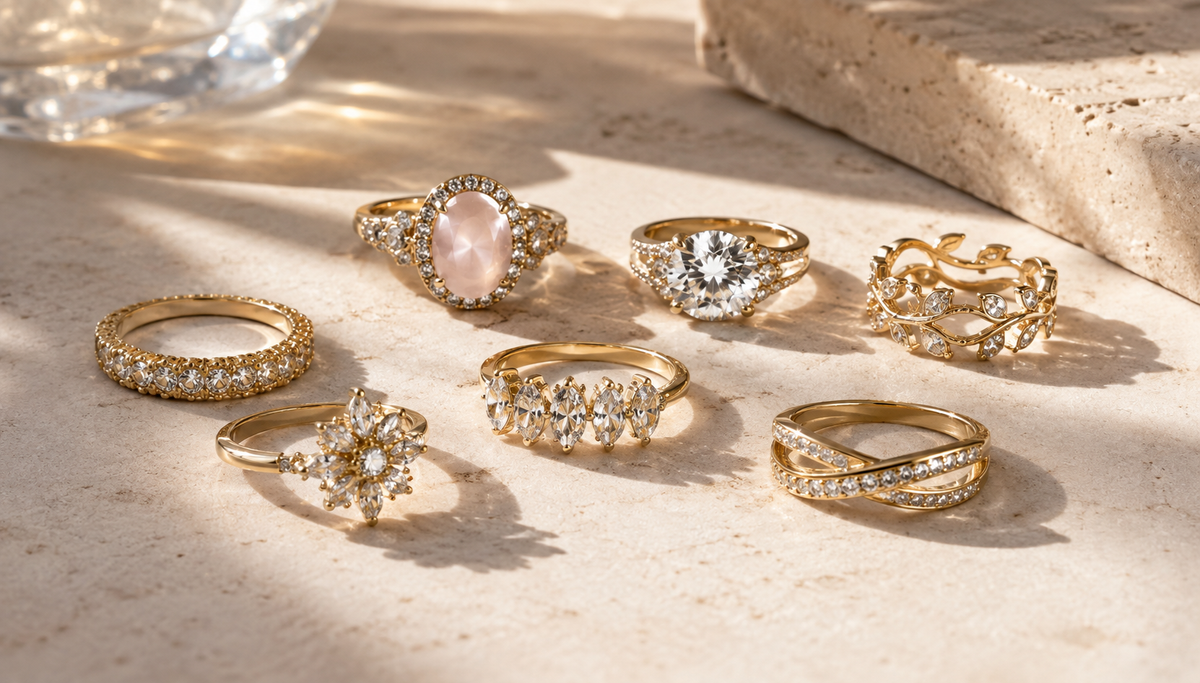
Online shoppers cannot pick up a ring and turn it under a display light. The design needs to communicate clearly through a screen. Strong candidates usually have recognizable details, attractive proportions, and enough visual interest to stand out in a product grid.
Buyers should also inspect how reflective surfaces, stones, crystals, textures, and finishes appear in photographs. Some rings look impressive in person but lose their character when photographed from one standard angle. A retailer should ideally obtain several images before committing to a large order. Close-ups, side views, top views, and photos worn on a hand can make a major difference.
#3 Check Materials and Finish Details Carefully
A wholesale buyer should know exactly what the retailer will tell the customer. That means checking the base metal, plating or coating, stone or crystal type, finish, and care requirements. Supplier descriptions should provide enough detail to create accurate product listings.
This is also an area where retailers can distinguish their stores. Instead of writing vague descriptions such as "beautiful high-quality ring," a product page can explain the actual finish, design details, stone color, dimensions, and recommended care. Specific information builds confidence.
#4 Treat Sizing as a Business Decision
Ring sizing deserves more attention than it often receives during wholesale buying. A retailer should examine the size range offered, determine which sizes sell most naturally for its audience, and check how consistently the supplier produces each size.
For online stores, size information needs to be especially clear. A simple ring sizing guide, measurement instructions, and product-specific sizing notes can help customers make better choices. It is also useful to examine the design itself. Wide bands, unusually shaped rings, adjustable designs, and stacked styles may fit differently from simple bands.
A retailer should consider these differences before assigning a single generic sizing message to every product.
#5 Calculate the Real Cost, Not Just the Wholesale Price
A ring that costs $4 wholesale is not really a $4 inventory expense. The retailer should account for shipping, packaging, payment processing, marketplace fees when applicable, photography, advertising, returns, discounts, and other operating costs.
A simple margin calculation can expose problems early:
Retail price - total product cost = gross profit
For example, a ring purchased for $5 and sold for $20 appears to produce $15 before other expenses. If packaging, shipping subsidies, transaction fees, promotions, and returns consume $6, the actual contribution becomes $9.
The goal is not simply to find the lowest wholesale price. It is to find products that can support the store's complete business model.
#6 Compare Minimum Order Requirements
Minimum order quantities can quietly shape an online store's inventory strategy. A low minimum order lets a retailer test several designs without investing too much in one style. A high minimum can make a popular-looking ring much harder to test.
Buyers should ask:
-
Is the minimum order per design or per overall order?
-
Can sizes be mixed?
-
Can colors or finishes be mixed?
-
Are sample orders available?
-
Can you reorder successful styles in smaller quantities?
These details can matter more than a small difference in unit price.
#7 Think About Reordering Before the First Sale
What happens when a ring sells faster than expected? An online retailer should know the supplier's typical lead time, stock levels, production schedule, and communication process before building a product around a particular style.
This is one of the less obvious parts of wholesale buying. A retailer may spend money on professional photos, optimized product descriptions, ads, and links to a product page. If the supplier cannot replenish the item, that marketing investment becomes harder to capitalize on. A reliable reorder process helps turn a successful product into a repeatable revenue source.
#8 Evaluate Trend Potential Without Filling the Store With Fads
Fashion jewelry naturally responds to trends, but an online store needs balance. Current industry coverage has highlighted stronger interest in bold, gem-forward cocktail rings, textured designs, layering, two-tone looks, and colorful stones and materials. That does not mean retailers should fill their entire inventory with every trend.
A practical assortment can include recognizable everyday designs, a smaller selection of trend-driven pieces, and a few statement styles that create visual interest. This gives customers variety while keeping the catalog commercially focused.
#9 Check How the Rings Fit the Rest of the Store
A ring should make sense beside the store's other products. If the store sells delicate necklaces and small earrings, adding extremely oversized cocktail rings may create a disconnected shopping experience. If the brand focuses on bold fashion jewelry, tiny minimalist rings may need stronger merchandising support. The best wholesale purchases often create combinations.
A retailer can group rings by color, style, occasion, collection, or price point. Stacking rings can be displayed together. Pair statement rings with complementary earrings. Colorful pieces can support seasonal collections. The objective is to make one product help sell another.
#10 Inspect Quality Before Scaling the Order
Samples matter because photos and descriptions cannot reveal everything. A buyer should inspect the ring's finish, stone placement, edges, weight, comfort, clasping or adjustable components, packaging, and overall construction.
It is also worth wearing the sample for a while. Does the ring feel comfortable? Does the finish look consistent? Does the design catch on clothing? Does it photograph as well in natural light as it does in a supplier image? These practical observations can prevent expensive inventory mistakes.
|
Buying factor |
What to examine |
Why it matters online |
|
Target customer |
Age, style, budget, lifestyle |
Helps prevent mismatched inventory |
|
Ring design |
Shape, proportions, details, versatility |
Determines visual appeal and merchandising potential |
|
Materials |
Metal, plating, crystals, stones, finishes |
Gives customers accurate product information |
|
Sizing |
Available sizes and consistency |
Reduces sizing questions and returns |
|
Photography |
Multiple angles, close-ups, scale |
Helps shoppers understand the actual product |
|
Wholesale price |
Unit cost plus other expenses |
Protects retail margins |
|
Minimum order |
Required quantity per style or order |
Affects cash flow and inventory risk |
|
Reordering |
Stock availability and lead times |
Helps maintain best-selling styles |
|
Packaging |
Protection and presentation |
Shapes the unboxing experience |
|
Supplier reliability |
Communication, quality control, fulfillment |
Supports consistent customer service |

What Makes a Ring Easier to Sell Online?
The most e-commerce-friendly rings usually combine three qualities: clear visual identity, understandable product information, and a price customers can quickly justify.
This is especially important because jewelry shoppers often research before buying. In a 2025 Helzberg survey, 56% of respondents said they wanted to buy engagement rings online, while Gen Z respondents reported heavy use of social media for jewelry education and inspiration.
Although fashion rings are different from engagement rings, the buying behavior offers a useful lesson. Digital shoppers want information that helps them choose confidently.
For a fashion ring, that can mean showing the ring on a hand, providing exact measurements, explaining the materials, displaying multiple angles, and giving practical care instructions. The product page becomes part of the merchandise.
How Many Styles Should an Online Store Test?
A retailer doesn't need hundreds of ring designs to learn what customers like. A smaller test assortment can provide useful information while keeping inventory manageable. The retailer can monitor sales, add-to-cart rates, customer questions, conversion rates, and repeat purchases.
The important point is to evaluate styles by performance rather than personal preference. A buyer may love an unusual ring that receives little attention. On the other hand, another simple design may quietly become one of the store's strongest sellers. But sales data still gets the final vote.
Frequently Asked Questions
Should an online-only store buy many sizes of every ring?
Not necessarily. The best size mix depends on the store's customer base and previous sales data. New retailers can start with a practical size range, monitor demand, and adjust future orders around actual purchasing patterns.
How can retailers tell if a wholesale ring will photograph well?
Retailers should request sample pieces and photograph them in the same conditions used for their online store. Close-ups can reveal whether stones, finishes, textures, and small design details remain visible on screen.
Should an online jewelry store prioritize trendy rings or classic styles?
A balanced assortment usually gives retailers more flexibility. Core styles can provide continuity, while trend-focused designs can create fresh reasons for shoppers to visit the store. Industry trend reports show that jewelry preferences can shift toward stronger colors, textures, layering, and statement silhouettes, making trend pieces useful as part of a broader assortment.
What supplier questions matter most before placing a large ring order?
Buyers should ask about material specifications, size consistency, minimum quantities, sample availability, current inventory, reorder timing, quality control, packaging, shipping, and procedures for handling damaged merchandise. These questions help reveal how well a supplier can support an online retail operation after the initial purchase.
How can retailers decide which rings deserve repeat orders?
Sales volume is a starting point, but it should not be the only measure. Retailers can also review conversion rate, customer feedback, return patterns, repeat purchases, average order value, and how often shoppers purchase related products. A ring that consistently contributes to larger orders may be more valuable than one that sells frequently at a very low margin.
Final Thoughts
Buying wholesale fashion rings for an online-only store requires a merchandising mindset. The strongest wholesale decisions connect customer preferences with product quality, photography, sizing, pricing, supplier reliability, and long-term inventory planning.
Retailers should think beyond the first order. Can the ring be photographed effectively? Can customers understand it without touching it? Can the store price it profitably? Can the supplier replenish it when sales pick up? Does it fit the rest of the catalog?
Those questions turn wholesale purchasing from simple product sourcing into a more deliberate retail strategy.
For online jewelry businesses, wholesale fashion rings can become valuable parts of a product mix when retailers choose them based on customer demand, presentation, margins, and measurable sales potential. The smartest approach is simple: test thoughtfully, study the results, and let real customer behavior guide the next order.